

The robot in surgery first appeared around the 2000s. Today, more than 1700 robots are used in countries outside the European Union, mainly in the United States, and only 500 robots are used in the EU. Robots help to assist surgeons and provide greater precision for difficult and meticulous procedures; they also improve technical capabilities as well as the comfort of surgeons and patients.
The Da Vinci Robot
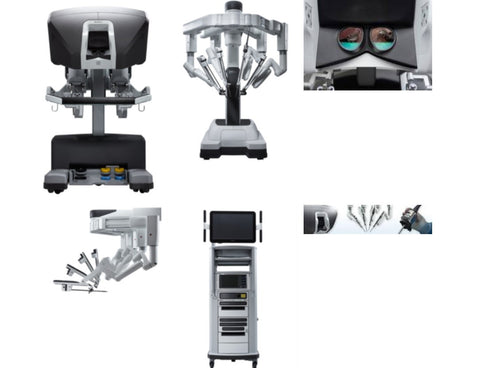
The Da Vinci robot is a machine measuring 2 meters in wingspan and weighing 650 kg. It has 4 main components:
- The surgeon's console
- The multi-arm telemanipulator on the patient's side
- Surgical instruments
- The high-resolution 3D vision endoscope connected to a digital image analyzer
The Da Vinci robot allows complex procedures to be performed more easily with very high precision, no tremors, and highly ergonomic movements.
Advantages and disadvantages
The advantages of such a technological feat are:
- 3D vision
- Precision of movements
- Rotation of instruments
- Comfort
- Halves hospital stay
The disadvantages are:
- The price of the device
- Extended operating time
- Cost and duration of robot training
The ultra-sophisticated Da Vinci robot in ophthalmic surgery
Even though yesterday the Da Vinci robot was mainly used for laparoscopic procedures (a surgical technique that allows interventions on the viscera of the abdominal cavity with minimal opening of the abdominal wall), since the end of June 2014 it has been used for ophthalmic surgery. Professor Tristan Bourcier, an ophthalmologist in Strasbourg, performed a corneal transplant on three patients suffering from chronic ulcers. For him, this type of robot-assisted surgery offers more precision, filters tremors, reduces the amplitude of movement, and improves the ergonomics of the gesture.